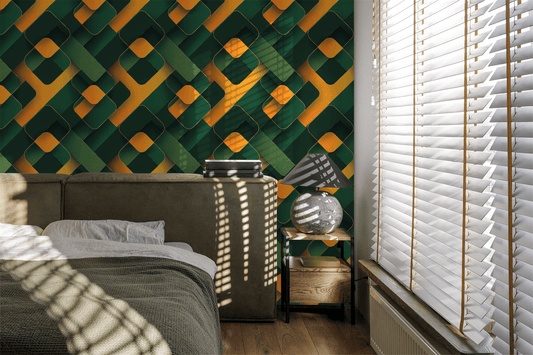
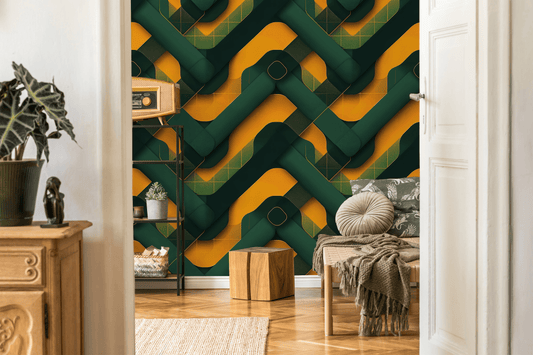
Where ceremonial precision meets organic movement.
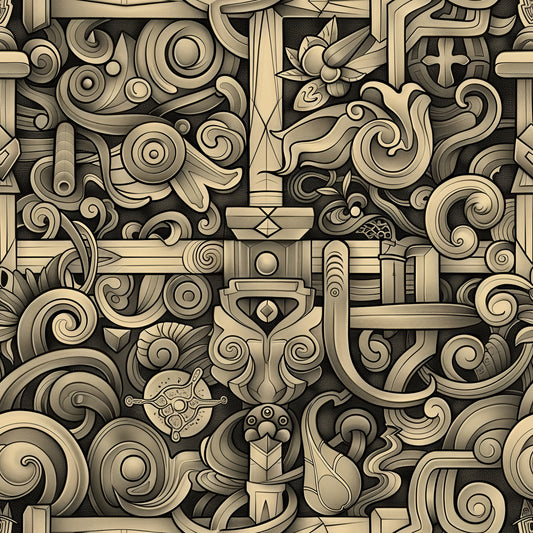
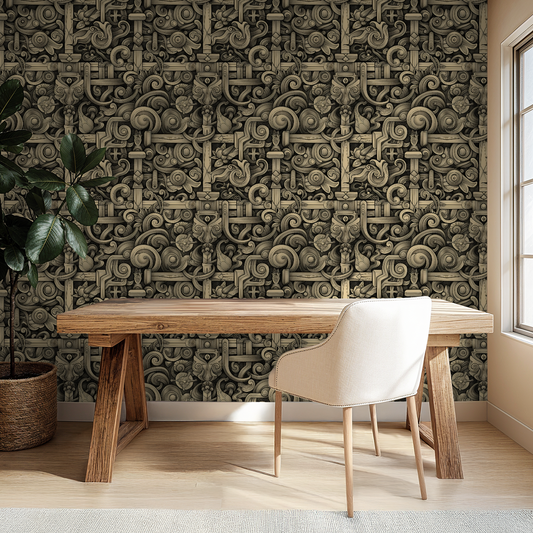
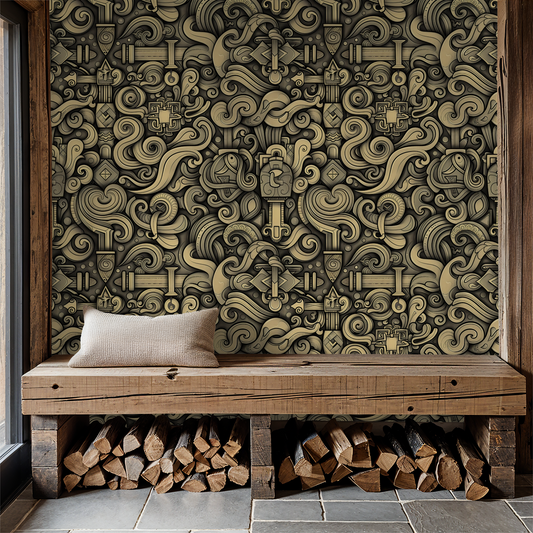
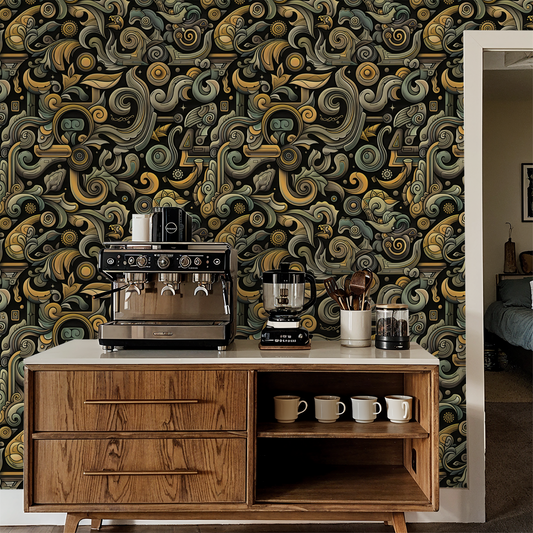
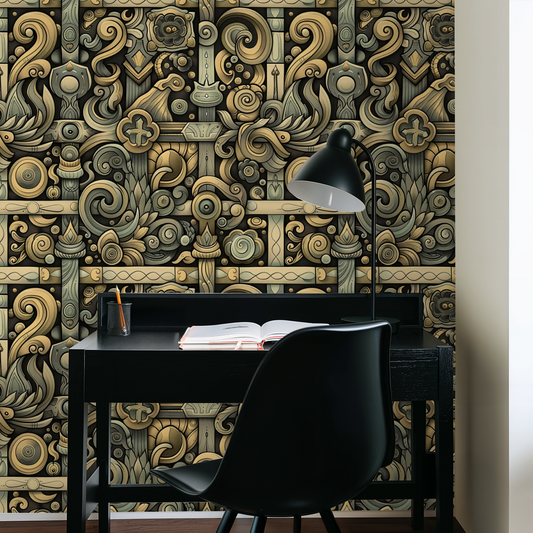
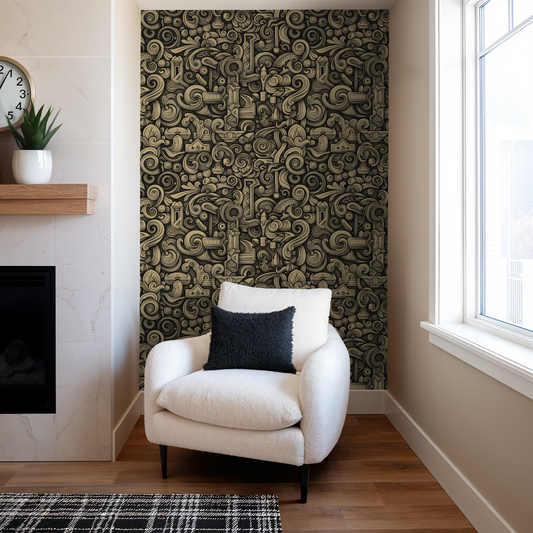
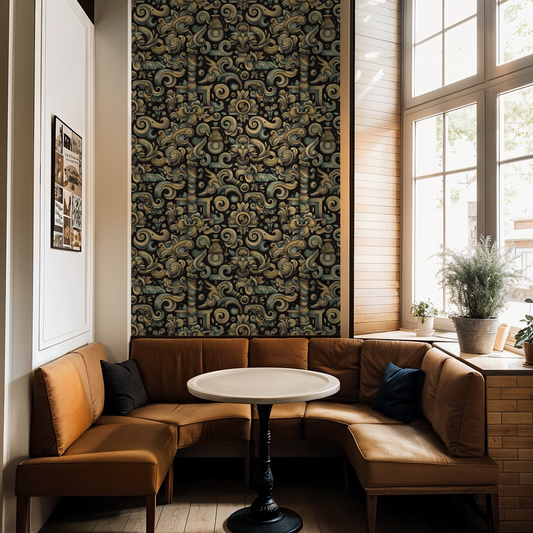
Ritual Spin gives you the most architectural focus in the Aztec Underground collection—prominent columns, key-shaped medallions, and stepped geometric forms create clear focal points while spiraling scrollwork weaves through the negative space to prevent the composition from feeling static. The sage green elements provide breathing room between the dominant golds and bronzes, creating visual pathways that guide the eye through the density rather than overwhelming it. The dimensional rendering emphasizes the structural elements most strongly, making columns and geometric forms pop forward while the organic curves recede slightly. It's the collection's exercise in hierarchical composition.
The vibe: Temple architecture meets intentional asymmetry. Structured but not rigid. The kind of pattern where you can identify individual elements—that's definitely a column, that's clearly a ceremonial key—but they're arranged with enough irregularity to feel discovered rather than designed.
Works beautifully in: Design-forward offices, upscale barbershops, craft distillery tasting rooms, boutique gym reception areas, creative coworking spaces, restaurant private dining rooms, architectural photography studios, or any space where "grounded but adventurous" is the objective. This is for people who want recognizable forms without predictable arrangement.
Real talk: Ritual Spin stands out in Aztec Underground for having the most identifiable architectural elements—those columns and geometric forms give your eye places to rest, which makes the pattern feel less chaotic than Temple Flux despite similar complexity. This makes it simultaneously the most approachable and most deliberately composed design in the collection. The clear structural elements can anchor a space and provide visual stability, but the asymmetrical arrangement means pattern matching at seams requires attention if you're doing multiple walls. If you prefer Serpent Hall's denser ornamentation or Conquest Coil's all-over coverage, Ritual Spin's breathing room and distinct focal points might feel too organized. But if you're drawn to that specific balance—the idea that complexity needs anchor points to feel navigable—Ritual Spin articulates that philosophy clearly.
The prominent architectural elements create strong shadow definition that emphasizes the relief effect in angled lighting, while the sage pathways prevent visual fatigue by giving the eye somewhere to rest—meaning the pattern feels less overwhelming in smaller spaces than its density might suggest.
For people who appreciate structure within chaos, design professionals who understand that focal points prevent overwhelm, architecture enthusiasts who value interpretation over accuracy, and anyone who believes bold patterns still need compositional logic.
Available across three material tiers—because ceremonial presence deserves intentional foundation.
Collection note: Part of the Aztec Underground series, where we reimagine ceremonial architecture through contemporary abstraction, celebrate dimensional complexity, and prove that ancient inspiration doesn't require literal translation.
First wall? Our measuring guide takes ten minutes, and the peel-and-stick and paste-the-wall install guides walk you through hanging day.